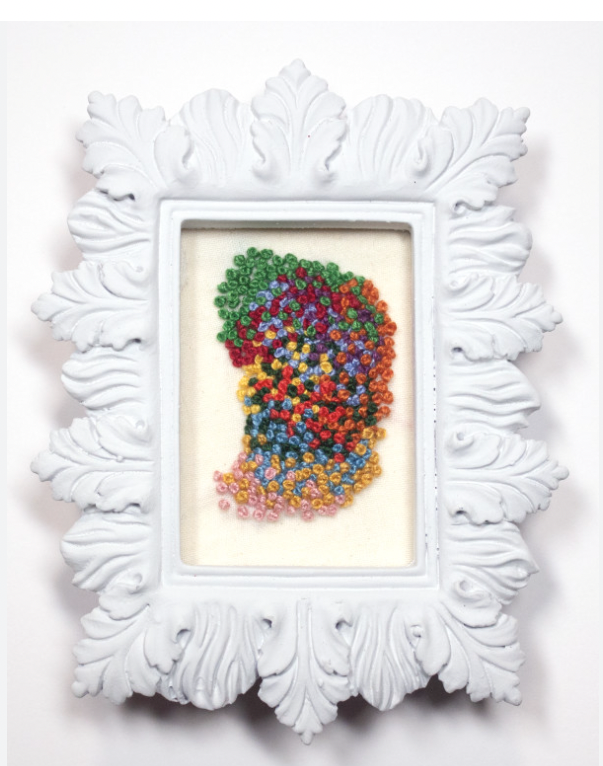
Redefining Narratives and Healing in 121.25 (Four Hundred and Eighty-Five French Knots), from French Knots for Trade Project
The exhibit, Alternative Medicine: Healing Remedies for Harmful Times aims to achieve an array of objectives. This display showcases the dual nature of pharmaceuticals, underscoring its precariousness between harmful medical effects and the prospect of healing. Furthermore, through the multitude of art forms including sculptures, videos, paintings, and embroidery, numerous perspectives emerge that are often overlooked. In showcasing work created by women and individuals of color, the Alternative Medicine collection reveals who is often excluded from the current healthcare structure in which private insurance companies operated by white men predominantly dictate cost, access, and types of care of patients.
Additionally, the gallery showing aims to depict how value is determined through the exclusion of certain demographics from the established systems and narratives driving remedies. Thus, another goal of this display is to depict alternative methods for treatment that involve individualized attention, extended durations, and more cognitive pursuits.
In regard to the different forms of treatment, the artwork within the exhibit illustrates an alternative definition to healing that surpasses its function as the mere mitigation of physical pain. More extensively, healing includes the improvement of understanding one’s feelings and outlook regarding other disciplines such as politics, economics, and as stated in the exhibition guide, better developing “the relationships that bind us together” as human beings (Alternative Medicine: Healing Remedies for Harmful Times Exhibit).
I believe the exhibit was immensely successful in accomplishing these aims, as evidenced by the work, 121.25 (Four Hundred and Eighty-Five French Knots), from French Knots for Trade Project by Jeane Eva Klein. This piece in particular serves as the only form of embroidery in the Alternative Medicine collection, reflecting a specific form of healing that is rooted in a “meditative” quality (Klein). While completing her embroidery, Klein united her mind’s ability to wander, leading her to pursue the exhibit’s intention of showcasing aforementioned individualized attention, extended durations, and more cognitive pursuits, which all juxtapose the current healthcare system in the United States. The current structure intervenes when a patient is already sick, instead of focusing on early prevention and detection. This minimized involvement coupled with the primary fee-for-service model which pays providers for the amount of procedures they perform, incentivizes treating issues quickly.
Klein continues by questioning the “value of making itself” (Klein). Here, she grapples with how passage of time, as symbolized by the 485 French knots created, transforms into a numerical price or value. Her inquiry is solved when she reaches an economical solution of making payment into donation by requiring that the money used to purchase the artwork be donated in Klein’s name to Planned Parenthood. Interconnecting different forms of measurement, time into a fixed amount of knots, knots to money, and money to charity, exemplifies the healing that transcends alleviating physical pain. Klein instead heals by undergoing a reflection that joins a variety of disciplines with their own practices and definitions of meaning or value.
More insight is derived from Klein’s insistence that knots’ “existence is self-referential” (Klein). As it pertains to knots, they are single, closed curves and therefore, their only boundaries are themselves, creating a self-contained system. Similarly, during pregnancy, the maternal body builds an entirely new human being through its own biological resources. In this process, the mother serves as both the creator and environment which teaches the distinction between self and another person. Having made this connection, Klein’s work turned a private act of assembly into a statement appealing to politics and the public at large.
Starting with politics, the embroidery conducted in a private setting, is presented in a public gallery. By doing so and connecting her work to Planned Parenthood, Klein argues that personal decisions regarding “STI and STD testing and treatment, contraception, and cancer screening and prevention” are not merely private, but have become political matters demanding public attention (Alternative Medicine: Healing Remedies for Harmful Times Exhibit). The mentioned terms associated with personal decision making are all forms of care that possess high value for society and therefore require protection by the larger community of political authorities.
Also worthy of consideration is when Klein’s embroidery was purchased. The piece was bought in 2019 when Planned Parenthood faced scrutiny and threats of losing federal funding from anti-abortion advocates. With this in mind, the work defends Planned Parenthood services amidst intense political attempts to dismantle them by framing the defense of reproductive healthcare as a moral obligation of care and responsibility. This message coming from a woman, who is part of Planned Parenthood’s demographic, repositions the patient as an advocate. Klein’s argument furthermore reveals that those often excluded from traditional healthcare structures are the ones who possess or are susceptible to firsthand experience of being underserved.
By centering around the lived reality of those overlooked and disadvantaged, Klein’s work transforms individual struggle into a shared demand that promotes relationships that bind individuals. Now, people become connected through the protection and care for each other’s fundamental rights. Overall, I found the Alternative Medicine: Healing Remedies for Harmful Times exhibit’s objectives to be incredibly effective, as illustrated by the nuanced and multifaceted embroidery 121.25 (Four Hundred and Eighty-Five French Knots), from French Knots for Trade Project by Jeane Eva Klein. As I reflect one final time, admittedly, my analysis of her perspective is shaped by a limited personal experience with reproductive rights. However, by analyzing Klein’s work, I am able to better recognize how healing incorporates connection and deeper comprehension across a variety of fields, transforming individuals into a community seeking understanding.
Works Cited
Corso-Esquivel, John, and Lia Lia Newman. Alternative Medicine: Healing Remedies for Harmful Times. 2026, The Van Every/Smith Galleries, 315 N Main St, Davidson, NC 28036.
Klein, Jeane Eva. $121.25 (Four Hundred and Eighty-Five French Knots). 2014, Van Every/Smith Galleries, 315 N Main St, Davidson, NC 28036.
