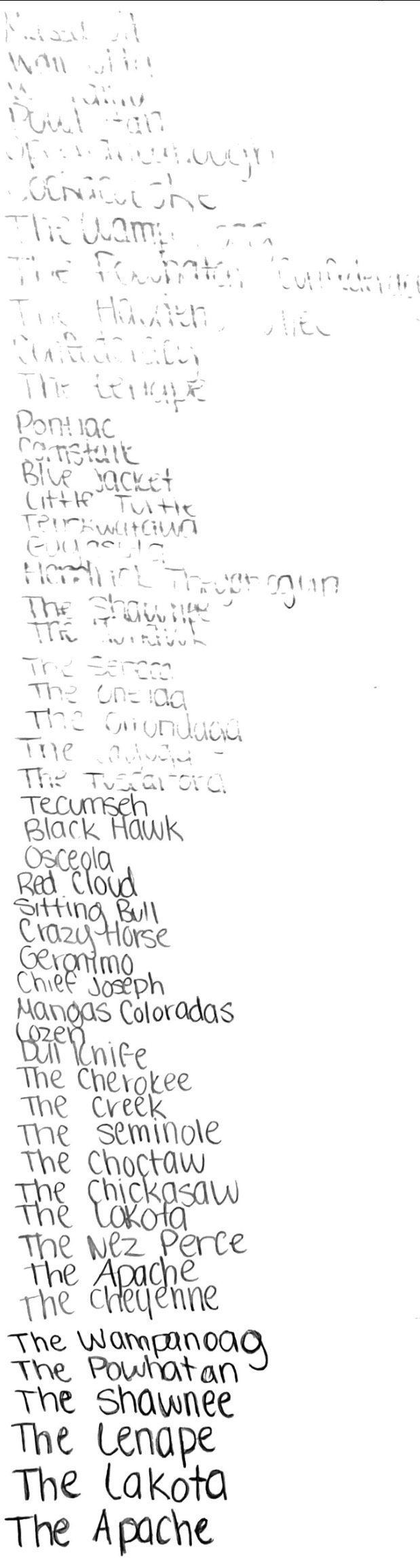
This scroll responds to John Locke’s idea in the Second Treatise of Government that inspired my portfolio theme of waste. Locke’s argument that ownership is attained through labor and improvement operates as a dangerous framework adopted by colonists especially during English settlement in the 1600s through the 1800s. These settlers justified the taking of Indigenous land by wrongly assuming it was empty or not used to its greatest potential.
The order of the names illustrates a chain of cause and effect. It begins with Indigenous nations already living on the land before and during early English colonization in North America. After, the list moves into early contact where Native presence begins to be misread through colonial ideas of waste. Later words then reflect leaders of resistance as those ideas become more forceful through expansion, removal, and conflict in the 1700s and 1800s. The scroll returns to collective nations at the end to show continuity rather than disappearance. In other words, the work is meant to list people and convey how “waste” is created, repeated, and used over time to create what is seen as valuable or empty.
The changes in spacing and visibility are not ranking importance, but instead show how perception is determined by this thought-process. Faint and spaced out sections reflect how Indigenous presence is misinterpreted as absence under Locke’s ideology, while more condensed and visible sections reflect how that logic becomes more potent through colonial expansion and resistance. This Something New is influenced by Percival Everett’s The Trees, where meaning builds from conducting research and grappling with identities and experiences to acknowledge and liberate. The scroll is meant to feel like it keeps being added to, so it is devoid of closure.
