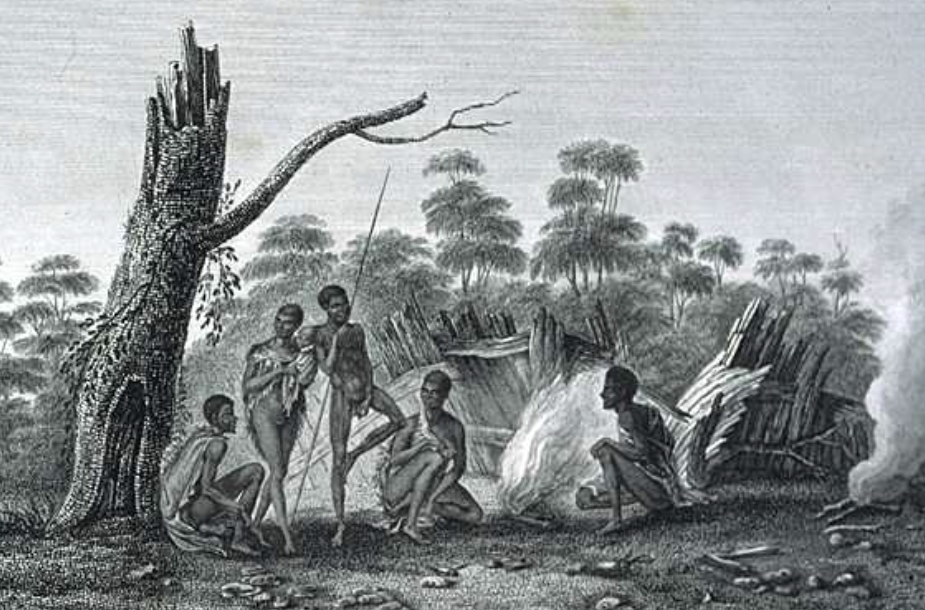
Justice is conceived from the recognition of others’ autonomy, perspectives, and ability to accumulate possessions. Refusing to impose superiority or interfere in another’s practices also maintains justice. Inflicting one’s philosophy and acting on such conversely creates injustice.
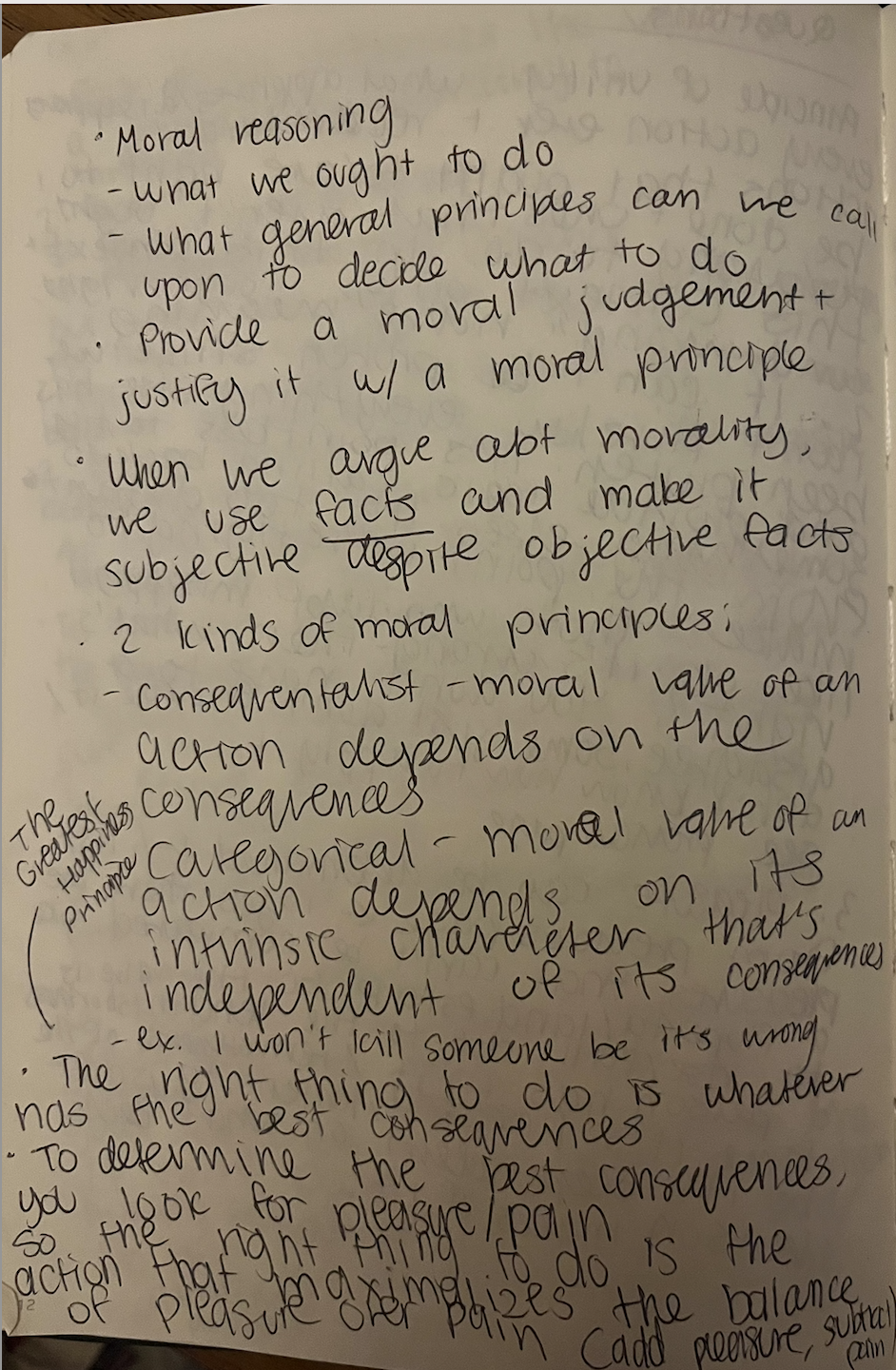
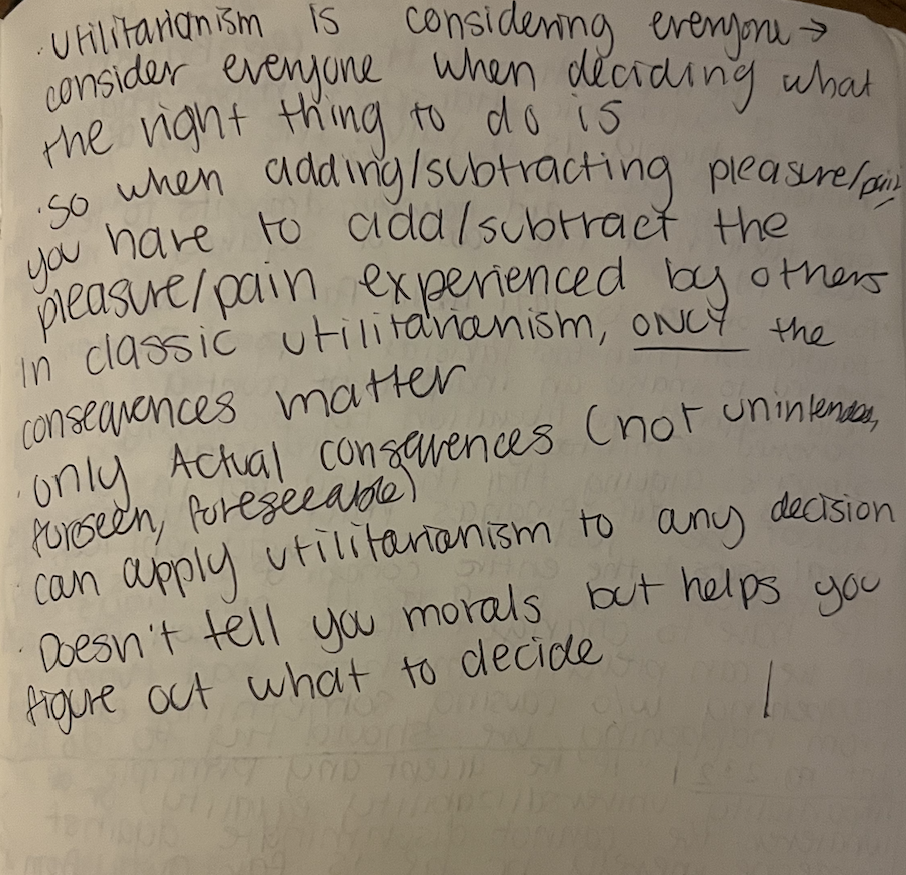
The shortcomings of Bentham’s philosophy illuminate this point. His “greatest happiness principle” claims that the morally correct action is the one that produces the greatest happiness for the largest number (Bentham 14). As Dr. Jankovic emphasized in her lecture on Bentham, utilitarianism considers only actual consequences, giving no moral significance to unintended or foreseeable outcomes. Yet history reveals that these byproducts often constitute the injustices that span generations and still shape inequity today. Charles W. Mills expands on such injustices in “‘Ideal Theory’ as Ideology,” critiquing political philosophy’s preoccupation with an imagined perfect society. Ideal theory, he argues, reflects the “interests and experiences” of “middle-to-upper-class white males” and excludes “women,” “people of color,” and “the poor and working class,” who endure “female subordination,” “centuries of white supremacy,” and “economic constraints” (Mills 172). Likewise, as discussed in Dr. Jankovic’s lecture on Locke and Rawls, Locke’s insistence that “no one is born a leader or subject” underscores the need to treat all individuals as autonomous (Locke). Both ideal theory and utilitarianism fail to do this because they assume a universal moral answer, ignoring the diverse experiences that shape human perspectives.
Recognizing autonomy also requires respecting possessions: extensions of individuality. Violations of this principle appear in Fredrick Luggard’s colonial ideology. As Dr. Wiemers explained in her presentation, Making and Enshrining Racial Hierarchies: The Imperial Project in Africa, Luggard argued that Africans misused their land, justifying European seizure. Such reasoning legitimized inhumane treatment and denied African autonomy, producing systemic injustice. This denial resonates in M. NourbeSe Philip’s Zong!, a work composed from the Gregson v. Gilbert case that justified murdering enslaved Africans for insurance claims. By reconfiguring the case’s language, Philip recreates the disorientation of the enslaved while reclaiming the colonizers’ words to restore voices and individuality vital to justice.
In Death and the Maiden, the preservation of individual beliefs remains crucial. As explained in Dr. Lipsker’s presentation, Justice Between Truth and Reconciliation, Gerardo struggles between supporting Paulina’s demand for a confession and honoring the truth commission’s legal process. His lack of introspection leads him to misrepresent both himself and Paulina, inadvertently perpetuating injustice.
Other figures demonstrate how justice can be upheld. Former Supreme Court Justice William Brennan, discussed in Dr. O’Geen’s lecture, William Brennan, the U.S. Constitution and Human Dignity, centered his constitutional interpretation on human dignity. His philosophy acknowledged individual perspectives and limited government intrusion, thereby upholding justice.
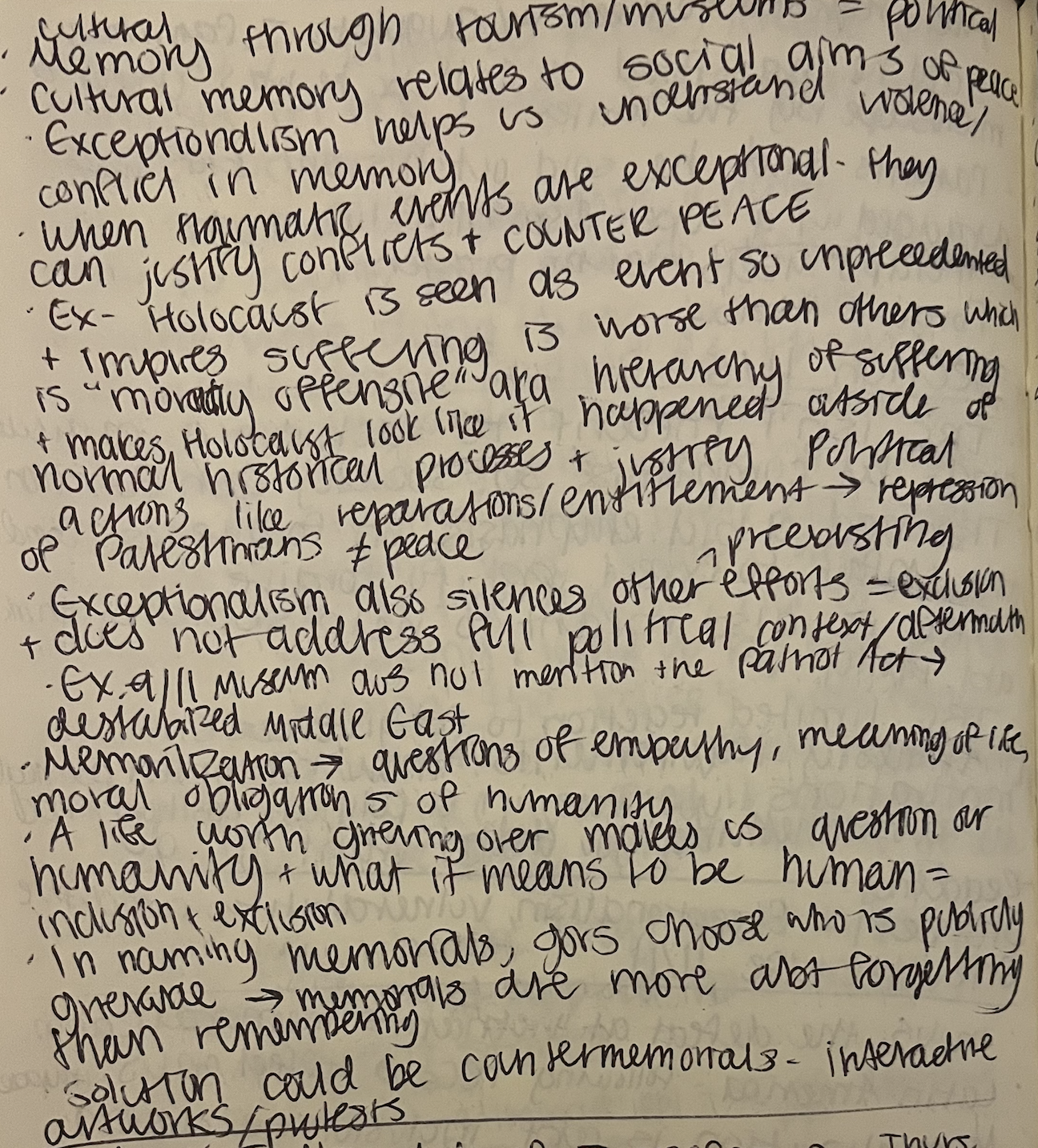
Marita Sturken offers further insight in “Cultural Memory in the Wake of Violence,” arguing that treating traumatic events as exceptional creates “a moral cushion that disallows counternarratives” (Sturken 66). As Dr. Lipsker noted in his lecture on Memorialization and Commemorialization, interactive monuments resist this by engaging viewers directly, preventing a single narrative from dominating and allowing individuals to form their own interpretations.
Across these thinkers and examples, justice emerges from honoring individuality, autonomy, and experiences. When societies respect diverse perspectives, refrain from imposing superiority, and protect the possessions and narratives that shape identity, they uphold justice. When they fail to do so, injustice inevitably follows.
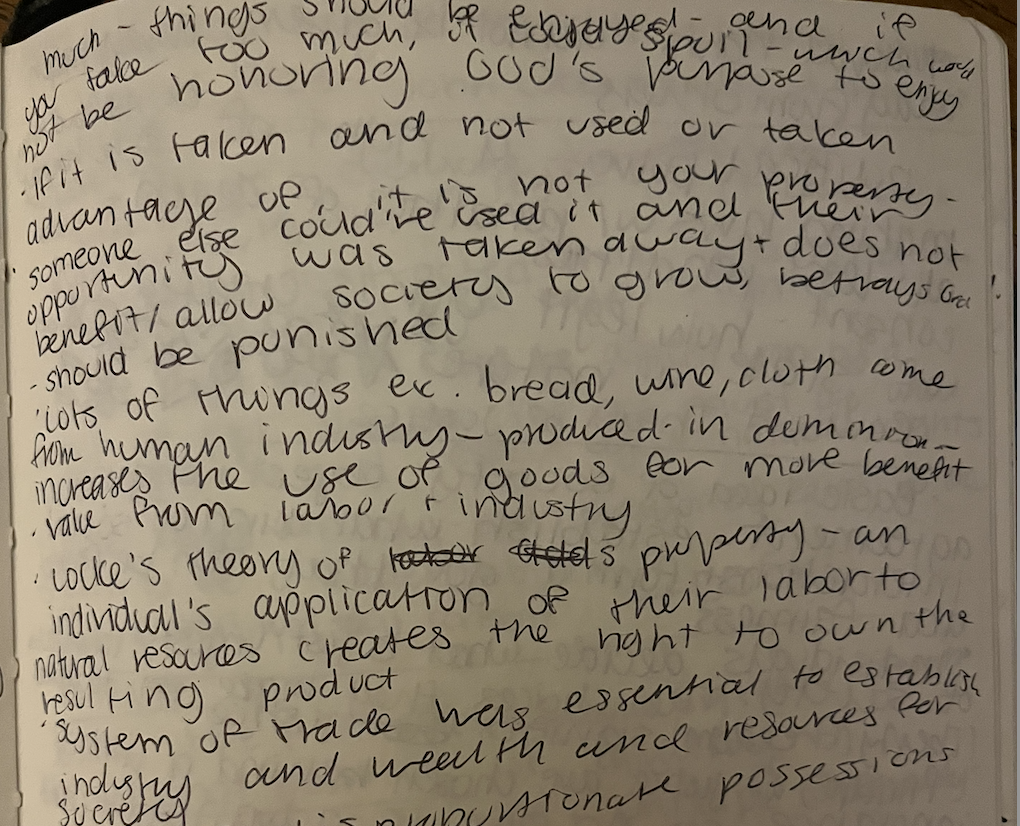
Notes that inspired my thinking:
Works Cited
Bentham, Jeremy. “Principles of Morals and Legislation.” Google Drive, Batoche Books Kitchener, 1781, drive.google.com/file/d/1WlyLMxknknklO3eQPCk2uOQbkoEeSGcr/view. Accessed 16 Dec. 2025.
Brennan, William. “The Constitution of the United States: Contemporary Ratification.” Collections of the Manuscript Division, Library of Congress, Google, 12 Oct. 1985, drive.google.com/file/d/13Ih_zXbM4Yg4DE3IvJBlahBvzOnIfRl3/view. Accessed 16 Dec. 2025.
Dorfman, Ariel. “Death and the Maiden.” Google Drive, Nick Hern Books, 1991, drive.google.com/file/d/1NczerzRlmq4K3HnJoR3Yh64E46wZfPDw/view. Accessed 16 Dec. 2025.
Jankovic, Marija. “Lecture on Bentham” Humanities 103-0, September 2025, Davidson College. Hance Auditorium. Lecture. Accessed 16 Dec. 2025.
Jankovic, Marija. “Lecture on Locke and Rawls” Humanities 103-0, September 2025, Davidson College. Hance Auditorium. Lecture. Accessed 16 Dec. 2025.
Lipsker, Yaakov. “Justice Between Truth and Reconciliation” Humanities 103-0, November 2025, Davidson College. Hance Auditorium. Lecture. Accessed 16 Dec. 2025.
Lipsker, Yaakov. “Lecture on Memorialization and Commemorialization” Humanities 103-0, November 2025, Davidson College. Hance Auditorium. Lecture. Accessed 16 Dec. 2025.
Locke, John. “Second Treatise of Government.” Second Treatise Of Government by John Locke, Gutenberg Files, Dec. 1689, www.gutenberg.org/files/7370/7370-h/7370-h.htm?ref=americanpurpose.com. Accessed 16 Dec. 2025.
Mills, Charles W. “‘Ideal Theory’ as Ideology.” Wiley on Behalf of Hypatia, Hypatia , Summer, 2005, Vol. 20, No. 3 (Summer, 2005), 2005, drive.google.com/file/d/1wyKOBCQ8E9bf2wC71-pMHjOvX8SkvkZG/view. Accessed 16 Dec. 2025.
O’Geen, Andrew. “William Brennan, the U.S. Constitution and Human Dignity” Humanities 103-0, September 2025, Davidson College. Hance Auditorium. Lecture. Accessed 16 Dec. 2025.
Philip, M. NourbeSe. Zong! Weslyan University Press, 2008, https://drive.google.com/file/d/1x1Pp15Vl9GgEr6ZLuuAqH51VblC4ZwpF/view. Accessed 16 Dec. 2025.
Sturken, Marita. “Cultural Memory in the Wake of Violence- Exceptionalism, Vulnerability and the Grievable Life.” Google Drive, 19 Feb. 2019, drive.google.com/file/d/1oTwaV7F-SGG22hByj4fYO8dd8uj5pGcG/view. Accessed 16 Dec. 2025.
Wiemers, Alice. “Making and Enshrining Racial Hierarchies: The Imperial Project in Africa” Humanities 103-0, October 2025, Davidson College. Hance Auditorium. Lecture. Accessed 16 Dec. 2025.
