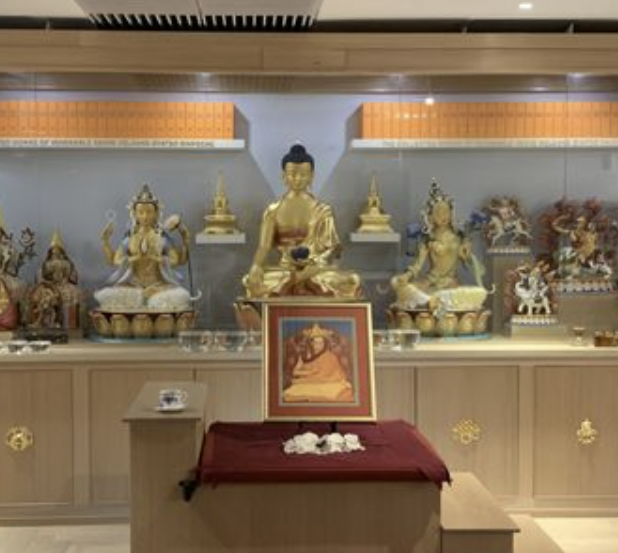
Kadampa Meditation Center in Charlotte
I visited the Kadampa Meditation Center to experience the Mahayana Buddhist teachings conducted in my Buddhism course with Dr. Pang. However, it is crucial to note that Kadampa is an independent school of Mahayana Buddhism and uses a curriculum based entirely on books by its founder, Geshe Kelsang Gyatso. In solely relying on Geshe Kalsang Gyatso’s teachings, I was unsure if the traditional teachings reviewed in class would be incorporated, making for this visit to serve as both exposure and education of new principles. Nevertheless, this distinction was not prominent during my visit.
The session began with approximately an hour of guided meditation accompanied by recitation of prayers by the attendees and Monk Norbu together, including what was referred to as the “Liberating Prayer.” Monk Norbu, who led the session, emphasized that meditation is a method of gaining control over the mind to regulate negative states, such as desire. “Negative” in this context refers to mental states that generate suffering or obscure clarity, denoting a categorization determined by the tradition’s own framework rather than any universal standard. Rather than seeking happiness from external sources, practitioners are encouraged to turn their attention inward, cultivating contentment separate from circumstances.
A recurring idea throughout the session was that these negative mental states must actively be reduced, allowing for positive ones to emerge. Monk Norbu suggested that without a spiritual motivation, individuals remain vulnerable to suffering and subjected to lower realms. Serving as a concept within Mahayana Buddhism, lower realms refers to states of existence, both metaphorical and literal, characterized by intensified suffering, and thus, Monk Norbu finds that a lack of cultivation of virtue leaves the mind susceptible to the whims of habitual and destructive emotions. Equanimity was then presented as a central goal of Buddhist practice, with Monk Norbu describing it as a state of mental balance free from fear and emotional instability. Within this context, fear itself was depicted as largely unproductive outside of its role in meditation where it can be recognized and eventually released. Through reliance on the Buddha as a source of refuge, practitioners are encouraged to disengage from habitual emotional responses and instead adopt a more compassionate awareness. Following the meditation, attendees shared a communal meal of rice, egg, and sweet potato, served to each individual by volunteers of the center. This portion of the visit reinforced the emphasis on intention, as even eating became an extension of the practice completely grounded in mindfulness, as opposed to excess.
The apparent goal of the speaker, Monk Norbu, was to both introduce participants to Kadampa practices and further demonstrate how these teachings could be integrated into daily life as a means of achieving enduring happiness. This goal was largely successful, particularly because of the immersive nature of the experience. Monk Norbu guided participants through Buddhism’s application, making concepts such as equanimity and mental discipline more tangible. The coherence between meditation, instruction, and communal activity contributed to a sense of progression, where each component reinforced the others. Even the simplicity of the meal seemed deliberate, subtly shifting the attention away from quantity or variety and toward simply having awareness of what was already present.
Simultaneously, my interpretation of the visit is shaped by my academic engagement with Buddhism, which emphasizes the diversity of beliefs and practices across traditions. Because of this, I remained aware of the specificity of Kadampa teachings and their reliance on a single and more modern authority from its founder, Geshe Kelsang Gyatso, which impacted how I understood its claims. The emphasis on controlling desire and redirecting the mind inspires a reconsideration of how value is assigned. If fulfillment is not found in external conditions, then distinctions between what is valued and what is not becomes less settled not because they are objectively meaningless, but because the framework itself questions who determines that meaning, and on what basis. The teachings suggest that much of what we treat as inherently desirable or undesirable is in actuality, a product of habitual mental patterns rather than any fixed quality of the thing itself. This realization unsettles conventional hierarchies of value in a way that felt both intellectually significant and personally disorienting.
Dissatisfaction in this context appears to stem from less of desire and more from the ways the mind categorizes and reacts to what is present. This perspective also reframes the role of negative mental states. Emotions including anger, greed, and fear were described not only as obstacles to clarity and compassion, but additionally as patterns that consume attention without producing meaningful fulfillment. In this sense, what is often treated as significant may, in actuality, drain energy and distort perception. The tendency to disregard particular experiences or conditions as unimportant or undesirable begins to appear less like an objective judgement and more like a reflection of habitual thinking. By encouraging practitioners to become aware of these patterns, the teachings suggest that what is overlooked is not lacking in value inherently, but shaped by how attention is directed.
Ultimately, the visit encouraged a shift in my own perspective that extends beyond the meditation session itself. Through emphasizing mindfulness and the cultivation of equanimity of equanimity, the teachings propose that value is contingent on perception. What is ignored, rejected, or deemed insignificant may not be intrinsically so, but the result of unexamined habits of thought. That realization carried over into my experience even after leaving. Later that day, while working through an assignment, I noticed myself dismissing a particular question as pointless almost immediately. What stood out was not the reaction itself, but more so how quickly it seemed to settle into certainty. I was not actively reasoning through why it lacked value, and instead decided that it already did. When I paused on that moment, it became clearer that the judgement about a habitual way of evaluating difficulty and relevance. Still thinking of this moment for longer, I could see that the sense of “pointlessness” was not inherent to the task, but something I had imposed on it. That made the process feel as though I was observing how readily my mind constructs an objective quality, often without much scrutiny. As a result, I remain contemplative and continue to reconsider how judgments are formed and sustained in everyday life.
