Lillian Kupersmit
16 February 2026
Davidson College Archives and Special Collections
425 Concord Road, Davidson NC 28036
Dear Davidson College Archives and Special Collections Staff,
I am writing to share my evolving historical research project, in which I aim to uncover
how institutions with substantial endowments impacted the social landscape of the cities and
towns they occupy. I am specifically focusing on the 1980s, as it was a period when colleges
increasingly used their financial resources and property holdings to influence revitalization
within their host communities and surrounding areas.
Davidson, North Carolina serves as a vital case study for my research. The college’s
considerable funding coupled with its large real estate holdings within the town contribute to its role as an economic, social, and cultural determinant. With this in mind, your archives are central to my studies, particularly materials from The Minutes and Correspondence section. These collections delve into 1980s revitalization efforts that were influenced and funded by Davidson College. Furthermore, your records touch upon the residents who opposed such change, which provides insight into those excluded in these large construction efforts backed by institutions. Using your records would lastly be integral in ascertaining why these construction projects were proposed and how institutional backing contributed to local power structures.
Thank you for your consideration,
Lillian Kupersmit
What Institutional Power Means for the Community: Studying 1980s Davidson
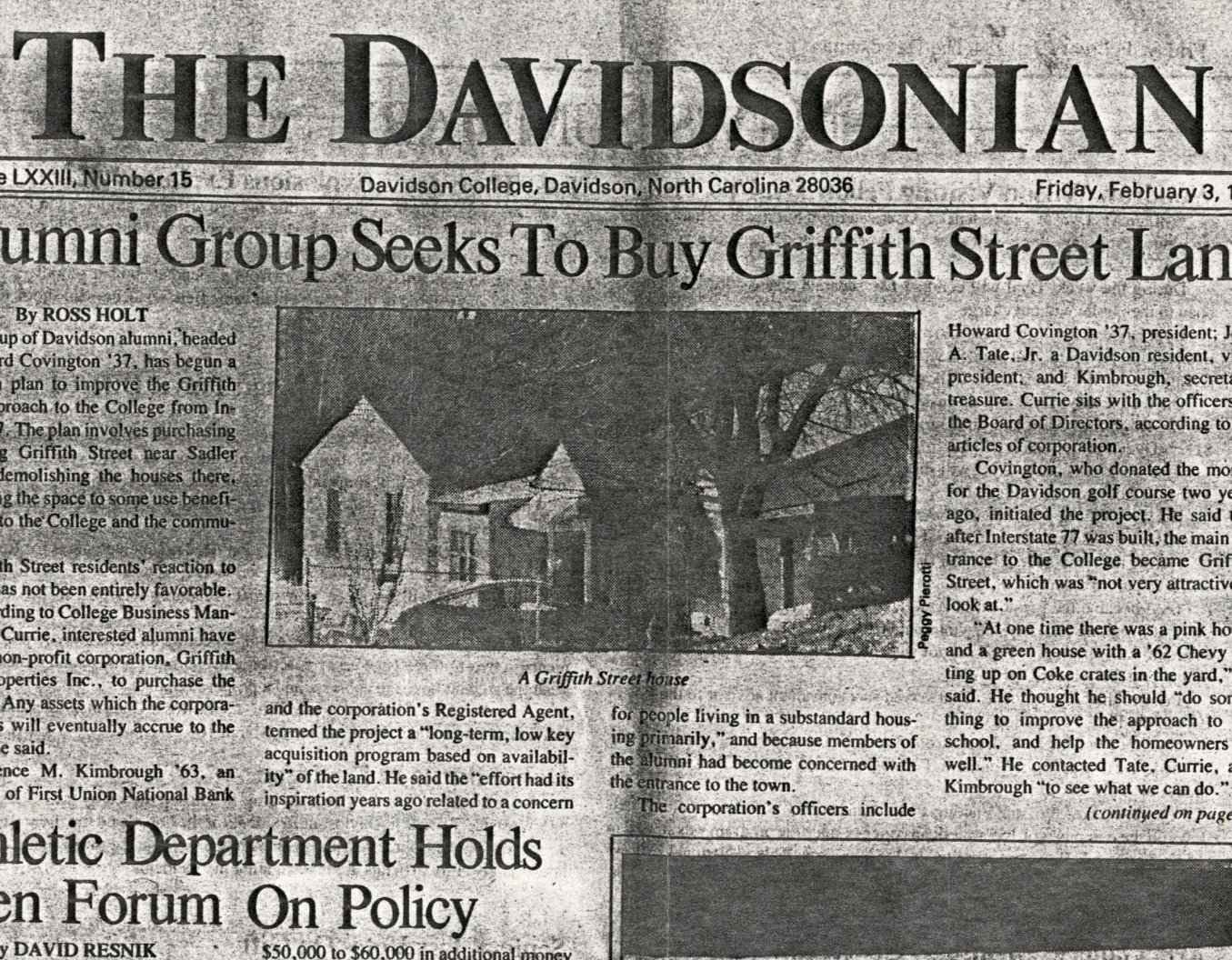
The Davidsonian-published article, “Alumni Group Seeks To Buy Land”, by Ross Holt, provides an insightful case study for understanding how institutions with substantial financial resources impacted the social landscape of the cities and towns they occupied in the 1980s. The piece outlines the formation of Griffith Street Properties Inc., a nonprofit corporation formed by Davidson alumni to purchase lots along Griffith Street, demolish houses, and create spaces they deemed “beneficial both to the College and the community” (Holt 1).
The corporation vowed to “preserve, restore, renovate, upgrade, and develop” the area along Griffith Street (Davidson 4). Despite framing the initiative as revitalization, the strategy involved long-term acquisition and destruction of existing homes in a residential neighborhood. While the College had “no direct financial investment”, the article explains that the land would eventually become its property and that the corporation received “interest-free loans from gifts received for that purpose” (Holt 4). This framework allowed the College to influence development indirectly, demonstrating how institutional authority in the 1980s could operate through alumni networks, nonprofit organizations, and property acquisition. Instead of purchasing land outright as Davidson College, the institution benefitted from a structure where alumni, such as Howard Covington who personally invested $75,000, funded purchases and planned construction, all while ensuring that property would belong to the College. Furthermore, the aforementioned use of interest-free loans and private alumni investment demonstrates how the College’s influence extended beyond its endowment, with alumni resources and social networks shaping development decisions close to campus.
The article also illustrates how these revitalization efforts affected existing residents and in some cases, excluded them from decision-making regarding their own homes. Some residents expressed fear of being “uprooted” or having to take on “a new mortgage” later in life, reflecting future concerns that elderly or retired homeowners would be displaced by the project (Holt 4). One resident observed, “Some say one thing, some another…most will sell,” underscoring the uncertainty and formidable pressure felt by neighborhood residents when presented with trade opportunities for lots with higher valuations. Others perceived the College and alumni as a powerful entity working against them, insisting “everyone else is in a league against them” (Holt 4). These reactions suggest that while the initiative was presented to make improvements benefitting the greater community, it primarily advanced the interests of the College and its supporters which isolated long-time residents. Those uninvolved were namely those in lower-income or historically Black neighborhoods, and thus, these groups became vulnerable to displacement and excluded from participation in decisions about their own properties.
Reflecting on how these dynamics correlate with the 1980s period, it is critical to observe how this decade saw many institutions extending their influences off campus through real estate development. Institutions increasingly engaged in acquiring and altering nearby neighborhoods, often using affiliated nonprofits and donor networks instead of purchasing the properties directly. An example from this period includes Northwestern University in Evanston. Here, neighborhood residents and small business owners resisted developments led by the university as they found the efforts threatened affordable housing and local commerce. Similarly, Temple University’s surrounding Philadelphia area engendered protests from residents who felt pushed out from rising rents and expansion efforts. These parallels denote that the Davidson Griffith Street example was not isolated, but included in a larger pattern where college’s financial resources and networks transformed municipalities and favored institutional goals over existing residents’ agencies.
Ultimately, the Griffith Street revitalization reflects a model of institutional expansion that is reminiscent of today’s dynamics. Universities still rely on endowments, donor networks, affiliated nonprofits, and real estate acquisitions to influence municipal development. Often, these projects are framed as mutually beneficial improvements, yet, the tensions seen in Davidson suggest a differing account. The residents’ fear of displacement and limited authority are central to current debates surrounding affordable housing, gentrification, and institutional input. By examining how Davidson College’s influence operated indirectly during the 1980s, this case offers insight into the structural dynamics that persist in relationships between universities and neighborhoods. Understanding this history is essential for evaluating how institutions can develop, while also including the community currently.
Works Cited
Holt, Ross. The Davidsonian. “Alumni Group Seeks To Buy Griffith Street Land.”
Davidson.Primo.Exlibrisgroup.Com, 3 Feb. 1984,
davidson.primo.exlibrisgroup.com/discovery/delivery/01DCOLL_INST:01DCOLL/1232148209
- Accessed 16 Feb. 2026.
