The Missing Piece to Justice
Top Middle Puzzle Piece:
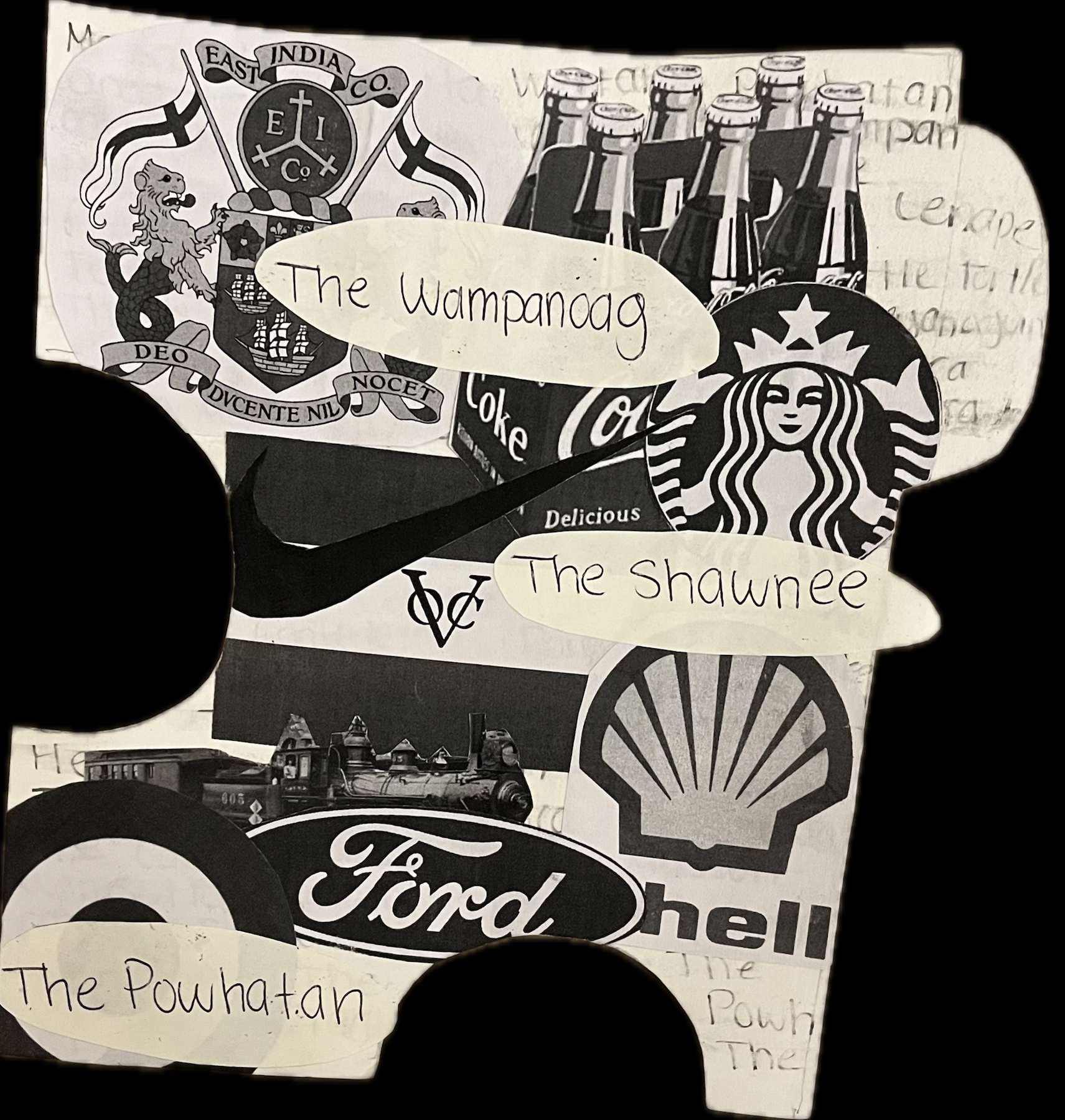
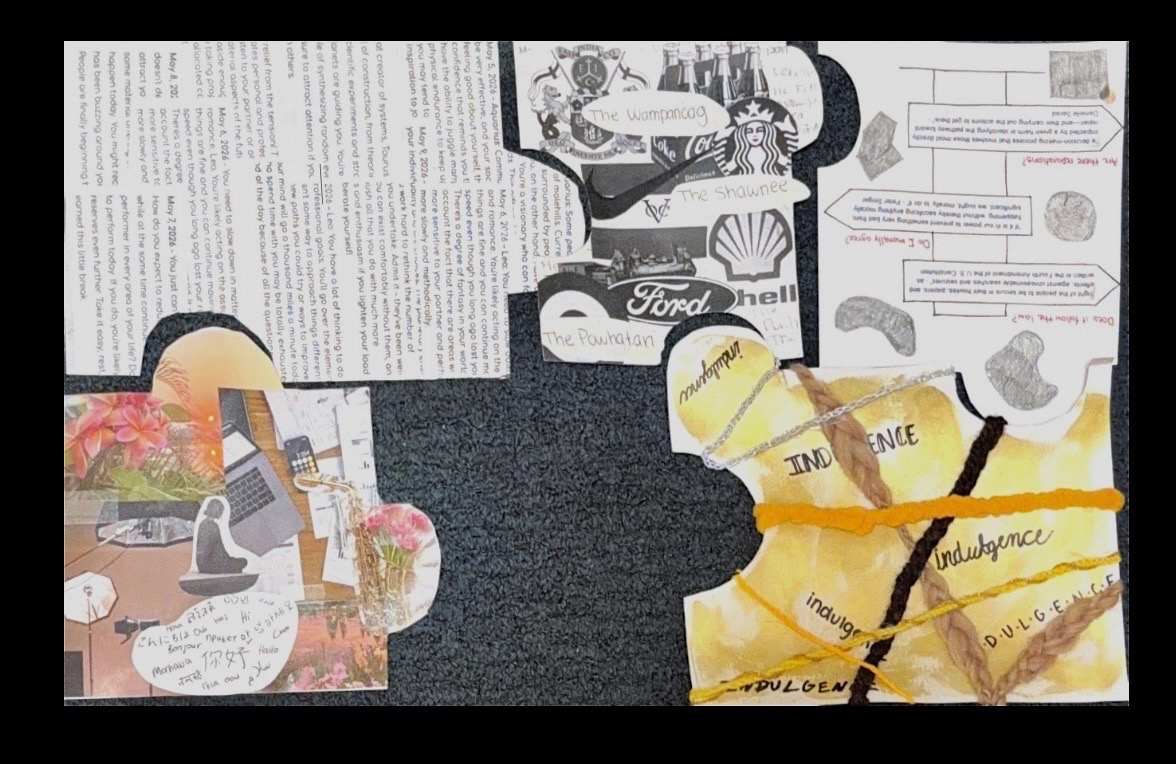
My puzzle piece brings together layered histories of colonial and capitalist extraction to expand beyond waste’s materialism. This something new further encapsulates the recognition and erasure aspects of my portfolio theme. The Indigenous nation names from my something new textual conducted this semester serve as the base of the piece due to their early presences and existences being destroyed by colonies and enterprises. These names are additionally faint due to their missing recognition from colonial forces such as the British East India and Dutch East India companies. The industrial railroad and Shell oil corporation take over through extraction and overproduction. However, modern capitalism defeats these forces, hence why the Starbucks, Nike, and Target logos are placed above them. Collective nations such as The Powhatan, Wampanoag, and Shawnee are then more clearly written, just as they were in my something new textual. They directly oppose current consumerism by asserting their own view that these companies are wasteful themselves.
This arrangement forces viewers to grapple with the differing perspectives of waste and how this concept has developed and remained prevalent over time.
Bottom Left Puzzle Piece:
Maya’s puzzle piece is meant to resemble Pandora’s box, wherein all the luxuries found in her theme of utopia can be found. The premise of her utopia, Arca, which is meant to draw people in is that any skill or desirable item can be achieved quickly. The pictures saying ‘Hello’ in various languages, the instrument, the business success as well as the photoshoot-success found easily in utopia. Yet, the figure in the middle lacks color, lacks joy (found in the hunched posture), and is not seen indulging in the beautiful nature either.
Corner Right Puzzle Piece:
Justine’s puzzle piece is an attempt to answer the question: is ___ just? Her theme is interpretation and she chose to represent this debate through the presence of reparations, upholding an individual’s morals, and the law. As interpretation depends on each individual, the grey shapes represent the grey area in making decisions regarding justice. It is not black and white. The orientation of the puzzle piece appears upside down, signifying that one’s interpretation might seem upside down to others.
Bottom Right Puzzle Piece:
Hannah’s puzzle piece is based on the theme of indulgence, specifically how indulgence operates within a system of decision-making. Her piece plays off the structure of how we make choices, especially the choices made to help produce justice. She used yarns of different colors and textures to represent the range of choices people make in the attempt to create justice. The contrast between the materials used also highlights how some choices hold greater weight than others. The braids are intersecting in order to suggest that every decision is not singular but entangled with diverse perspectives and biases. The fact that the yarn crosses over the words written across the piece symbolize how every decision has this underlying tension of indulgence. Ultimately, the piece emphasizes how indulgence is a decision-making factor that shapes the complex path towards justice.
This is because equality and happiness are not found in the easily accomplished. They are found in the lengthy pursuits, the fight for knowledge, and different structures meant to represent categories in society. It helps worldly efficiency. The collage is meant to draw in viewers, with later introspection of where happiness can be found.
Top Left Puzzle Piece:
Priscilla’s puzzle piece offers one way which humanity copes with a future which is unknown, horoscopes. Her piece has compiled the horoscopes of different zodiac signs, notably those of the creators of the puzzle pieces. In reading and analyzing horoscopes as a way in which humans grapple with the unknown, the individual can question their own methods of predicting the future. Horoscopes are only one example of belief systems which settle discomforts regarding the future. While people search out aspects of their lives in the excerpts which have been made to generalize emotions, one can question whether they are actually limiting themselves. Do the texts from a website, and the alignment of stars which they find their basis in, truly predict your day, or even your year? While this piece has chosen to focus on horoscopes, one could argue religion and meditation functions the same way. The piece ultimately is conveying the human tendency to yearn for knowledge of the future. However, one is also challenged to think on whether their destiny is preset, based on the medium which they chose, or in acknowledging the restraints put by such belief systems, is one able to write their own future.
